显示标签为“72h iptv free trial”的博文。显示所有博文

2019年11月13日星期三

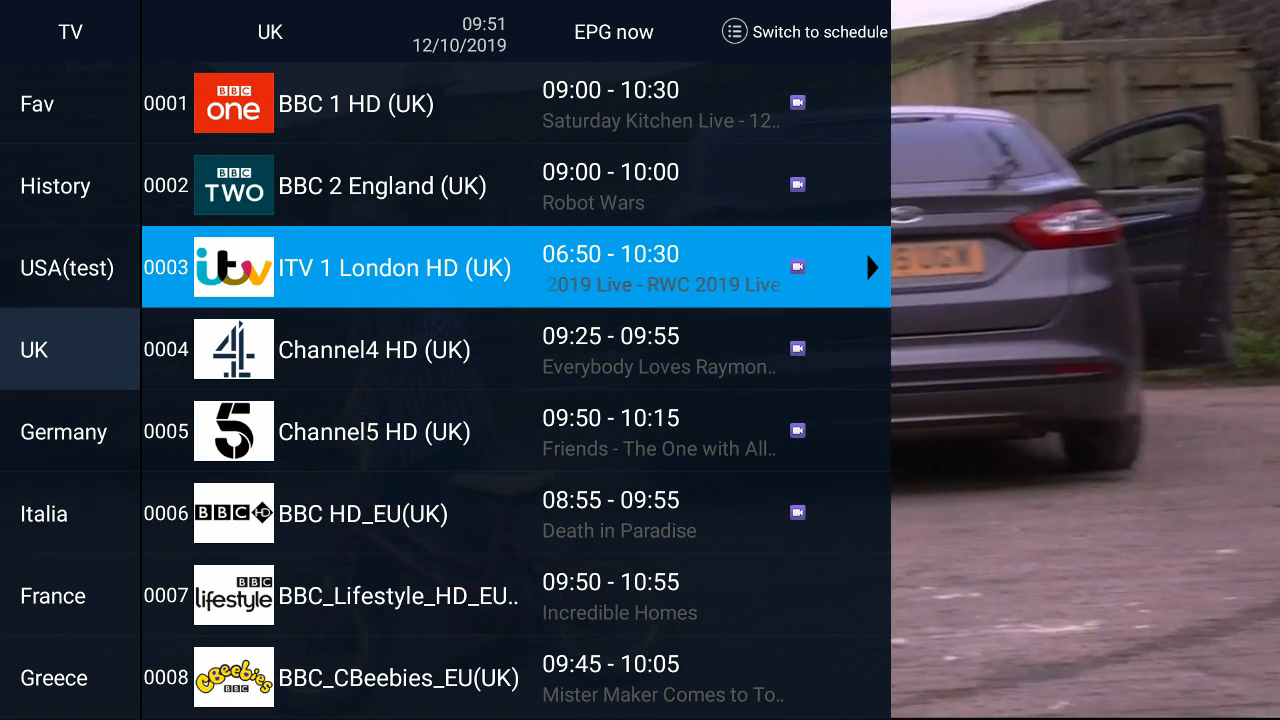
Different EPG styles formats of GTV IPTV. (IPTV Tutorial)


With the strong R&D engineering team, GTV IPTV is the most stable server with high-quality HD live channels and VOD movies and sports events. For the GTV standard package, we feature it with 7 days EPG with different style formats. For the Plus version, now it is with over 160 important channels and PVR recording functions. Sure, we are making it more wonderful features for our users all the time.

GTV IPTV with over 1000 very important live channels. Show the important channels and sport event channels
7 Days catch up: over 160 important channels with playback.
EPG functions: with Normal and classic & Gild format
For the introduction of EPG functions of different versions, please browse the comparison chart of IPTV EPG.
Normal EPG Style:
Grid EPG Style:

Classic EPG Style:


For the operation of catch up and EPG, please click GTV IPTV video tutorial

Record Function: Cloud PVR by self, Can Save forever.
3Days Free Trial Available


2019年10月28日星期一

The detailed working principle of IPTV and IPTV use guide.

Why do people you've never met decide what you can watch on TV and when? Sure, there is always a choice of channels, but the choice is quite limited. Unless you record the program in advance, you can only watch it when the program is broadcast. Wouldn't it be better if watching TV is more like browsing the web, so you can choose the program you want to watch anytime, anywhere? This is one of the promises of IPTV (Internet Protocol Television). It uses Internet technology to deliver TV programs on demand. How does it work? What benefits will it bring us? What challenges will broadcasters and telephone companies face in delivering these new services? Let's take a closer look!


What is IPTV?


From the perspective of TV viewers, IPTV is very simple: it does not receive TV programs from roof antennas, satellite antennas or fiber optic cables as broadcast signals to enter your home, but streams them through your Internet connection (download and play almost at the same time). It's not the kind of connection you have now, it might only handle 1-10 Mbps (megabits per second is about the amount of information that goes into your computer's novels on average per second!) But the bandwidth (information carrying capacity) of the broadband line is about 10 times of 10-100mbps. You can watch the program on your computer, or use a set-top box (an adapter for your Internet connection and your existing TV receiver) to decode the input signal so your TV can display the Internet program.

IPTV is a little more complex from a broadcaster's or phone company's point of view. You need a complex storage system to store all the videos you want to provide, as well as a network-style interface so that people can choose the programs they want. Once the audience selects a program, you need to be able to encode the video file into a format suitable for streaming media, encrypt it (only those who pay can decode and receive it), embed ads (especially when the program is free), and transmit it to anyone (potentially) thousands of people or millions of people at a time via the Internet. In addition, you have to figure out how to do this in order to provide a consistently high-quality picture (especially if you are offering ads with your programs, as this is something your paid advertisers will definitely look forward to).

Three types of IPTV


IPTV has three different styles. The first, which you may already be using, is called video on demand (VOD). With services like Netflix, you can choose a TV show or movie that you want to watch in a wide range, pay for and watch there. Some of the world's more aggressive broadcasters are launching another IPTV. In the UK, the BBC uses an online streaming video player called BBC iPlayer to play last week's shows online. This service is sometimes referred to as time-shifted IPTV because you watch regularly scheduled broadcasts at a convenient time. The third type of IP TV includes live TV programs on the Internet, because they are being watched, so it is "live IPTV" or "IP simulcasting". All three forms of IPTV can use your computer and a normal web browser, or (for better quality) a set-top box and a normal digital TV. All three services can be delivered over the public Internet or hosted private networks that work in essentially the same way (for example, from your phone and Internet service provider to your home entirely through the provider's network).

What is the "Internet Protocol" on IPTV?


IPTV stands for internet protocol TV, but what does "Internet Protocol" mean? This is the essence of Internet operation.

Send an email to a friend or download a web page, and the information you start won't spread as much as you expect. Instead, it is divided into many small pieces, called packets, each of which can be "exchanged" (sent) to a destination via a different route. As we all know, packet exchange is the basic principle of any information dissemination on the Internet. The computer that connects the network does not know what any given packet means or what it does. They only know the IP address (every computer on the Internet has a number "house and street name"), where packets have to be delivered, and they treat all packets the same.

The Internet is not designed to do something, such as sending an e-mail: it's just an efficient, computerized "post" system for sending millions of packets. The simple but amazing result is that as long as you can turn information into packets, you can send any possible information over the Internet. That's why the Internet can be used to send e-mail, Download Web pages, make phone calls (using a technology called "VoIP"), watch TV and do more than a dozen other things that have not yet been invented. If someone designs the Internet more strictly just to send and receive an e-mail, such as using it for other things, such as making a phone call or watching TV, it may not be possible.

How does IPTV work?


In traditional TV, programs are converted into radio waves, which are transmitted through the air to your roof antenna. The antenna converts the radio wave back to the electric signal, and your TV decodes it to produce sound and image (the principle of satellite TV is the same, except that the signal will be reflected to the space and back, while cable TV will send the signal directly to your home, without the radio wave).

How to stream IPTV


In order to watch IPTV content, you need a device to receive and decode the stream and a connected source that serves the channels, movies, and sports broadcasts you want. There are three devices that let you access streaming content:

Smart TV

Mobile phones and tablets

Set-top box

Stored program


Live programs will be streamed during production, but pre-recorded programs and movies need to be stored in a way that can be selected and streamed on-demand. Some VOD services limit the number of programs they provide, not because they lack storage space, but because it is a way to limit the total bandwidth of their services and their impact on the Internet. (for example, if the BBC offers every program it produces on its iPlayer for free, a large part of the Internet bandwidth across the UK will be consumed by streaming soap operas and sitcoms, which may slow down every kind of network traffic on the network.)

GTV IPTV provides recording function: cloud PVR self-storage, which can be permanently saved. To learn more about the GTV recording function, you can watch REC Guide on GTV IPTV Blog.

Preparatory procedure


First of all, TV programs (pre-recorded or filmed on-site by the camera) must be converted to digital format, which can be transmitted as data packets using internet protocol. Sometimes the original program is already in digital format; sometimes it will be a standard analog TV picture (called SD format), which needs additional processing bits (analog-to-digital conversion) to be converted into digital format. Due to the current bandwidth constraints, the video also needs to be compressed (compressed into smaller files) so that it can be transmitted smoothly without buffering (periodic delay caused by the receiver when establishing incoming packets). In fact, this means that the program is encoded in MPEG-2 or MPEG-4 format (MPEG-4 is a relatively new form of video compression, which provides higher quality for similar bandwidth, and the bandwidth required to carry SD pictures is only half of MPEG-2). Once this is done, the ad must be inserted and the information must be encrypted.

Streaming program


When you browse a website, you actually set up a temporary link between two computers so that one computer can "suck" information from the other. Your computer (client) obtains information from another computer (usually a more powerful computer) by directly linking to an IP address corresponding to the website you want to browse. There is a short, intermittent conversation between the client and the server in which the client requests from the server all the files it needs to build the page you are viewing. Servers are usually so fast and powerful that many clients can download in this way at the same time with little delay. This common download between a client-server and a server is called "IP unicast" (which most web browsing falls into).

IP Multicast


However, when it comes to streaming media (playing programs when downloading programs), the client creates a greater (simultaneous) load on the server, which can lead to unacceptable delays and buffers. Therefore, in streaming transmission, a different download method is used, which is called "IP multicast", in which each packet leaves the server only once, but is sent to many different destinations at the same time; in theory, this means that one server can send information to multiple clients as easily as to one client. Therefore, if 1000 people watch the World Cup finals on the Internet at the same time, they will receive streaming video packets from a server and send them to 1000 clients using IP multicast. If the same TV provider offers an episode of friends at the same time, and some of the first 1000 people decide to "switch channels" to watch it, they actually switch from one IP multicast group to another and start receiving different video streams.

The global nature of the Internet makes it difficult to send information from servers to local clients as reliably as to clients on the other side of the globe. That's why IPTV providers often use asynchronous global network on their servers, the so-called content delivery network (CDN), which keeps a "mirror" copy of the same data; then, people in the United States may stream programs from mountain view in California, while people in Europe may get them from Frankfurt in Germany.

IPTV protocol


When you stream a program, you don't download it like a normal file. Instead, you download a file, play it, and when it plays, download the next part of the file, ready to play in a minute or two. None of the files have been kept for a long time. Streaming works because your computer (the client) and the computer it receives data from (the server) agree to do so. The Internet has successfully connected almost all computers in the world because they all agree to talk to each other in the same way using pre-arranged technical programs called "protocols". Streaming media does not use normal, standard, web-based download protocols (technically, their names are HTTP and FTP), but uses protocols suitable for downloading and playing at the same time, such as RTP (real-time protocol) and RTSP (real-time streaming protocol). Multicast streaming includes using IGMP (IP group management protocol; you occasionally see books and web pages that replace m with "membership"), which allows a server to broadcast to members of a group of clients (in fact, many people are watching the same TV channel).

Managed network


Making IPTV available on the public Internet is very different from delivering through private and managed networks. Many IPTV providers will choose to do so eventually: by controlling the whole network, they can guarantee a certain quality and service levels. In fact, this means having a highly organized, hierarchical network with a national office called the "super front end" (she) that powers a regional center called the video center office (VHO), which in turn serves local distribution offices connected to individual family set-top boxes.

View program


Everyone with a computer and broadband Internet connection can watch IPTV, but most of us don't want to watch TV on a rough laptop screen. That's why the future of IPTV is likely to involve viewers buying set-top boxes (sometimes referred to as set-top boxes), receiving input from Internet connections (via Ethernet cables or Wi-Fi), decoding signals, and displaying pictures on HD widescreen TVs. The set-top box is actually a kind of independent computer. When programming, it only does one thing: receiving streaming video packets, decrypting them, converting them back to video files (MPEG2, MPEG4 or any of their original formats), and then displaying them as high-quality TV pictures. Apple TV is widely used in this way, using set-top boxes to run simple applications on a simplified operating system (tvos), which manages the process of video transmission over the Internet.


As a simple, more compact, more discreet alternative to set-top boxes, you can use the so-called dongle, which looks a bit like a USB flash stick but allows secure access to Internet TV programs. The dongle plugs into the HDMI (high-speed, high-definition digital video) outlet on your TV and connects to the Internet via Wi-Fi to play TV programs, movies, and music director. Some dongles are completely self-sufficient: Roku and Amazon firework-like this without any help from computers or mobile devices. Google's chrome cast is a little different: Generally speaking, you can use your computer, tablet or smartphone (it actually becomes a remote control), and then it transmits your movies or TV programs directly from the Internet.

What's the difference between a set-top box and a dongle? Simple: the set-top box is a larger box with a faster processor and more memory, so it can provide higher quality video output; this makes it more suitable for high-performance games, etc. Some companies, such as Amazon and Roku, offer either a simple, relatively expensive dongle or a more expensive, higher specification set-top box.

Fortunately, IPTV's development may be exactly the same as the development of broadband Internet in the early 21st century: at that time, as more and more people use the Internet, they felt hindered by the restrictions of dial-up connection, demanded (and indicated that they were willing to pay) higher quality broadband, and provided enough revenue for telecommunication companies. Upgrade their network. Once the audience begins to experience the convenience, control, and interaction of IPTV, the Internet connection with higher bandwidth seems certain to follow.

GTV IPTV - "the most reliable IPTV service" for HD streaming


GTV or GTV IPTV for short has almost become a household name in IPTV streaming. They use highly customized web streaming services and highly reliable streaming services to run quite complex services.

What's more impressive is the video on demand part, which covers more than 2500 films and more than 500 TV plays. GTV IPTV over 1000 very important live channels. Show the important channels and sport event channels. However, what distinguishes radio and television from other services is their sporting events. This is their own "live sports" list, each of which has multiple link channels.

Last but not least, GTV Plus(red) over 160 channels 7 days catch up+ important sports and events., allowing you to watch anything you might miss.

As you know, GTV IPTV is not a joke in terms of function. Fortunately, the quality and reliability of this service are not high. They have been around for a long time and know-how to run IPTV services.

2019年10月22日星期二

How to choose an IPTV provider for you?

With the popularization of the Internet to the family and the progress of technology, IPTV is more and more popular with its convenient and rich advantages. With IPTV, even if there is no cable from one room to another, there is no need to install a dish. When you travel, you can even bring your IPTV box around the world.

But how to choose an IPTV provider for you? What are reliable IPTV services and what is suitable for you? Maybe it's not an easy job for most of you. It's almost impossible to please everyone with an IPTV service. Some are looking for live TV from the UK, others need more exotic international channels, while others focus on VOD content. Combining all of these needs and trying to still deliver a rock-solid service is extremely difficult, and most fail. IPTV subscription does not want to be Jack of all walks of life. Their focus is very clear: to provide a reliable IPTV service focusing on English TV for the whole family.

So the first but not the most important thing is what you want to see. For example, the GTV high-definition IPTV, which is now popular in the UK and some European countries, has more than 1000 popular live channels in the UK and other countries, more than 3000 latest movies and important sports events. You can find news and local TV: BBC, ITV, Rai Uno, Zee, Almaty, 24doc, Alsat, Arena, Balkan retro hit... And popular sports programs, such as EPL, Premier League, SKY SPORT, bein sport, Nova, Ligtv, OTE, EuroSport, Skynet sport, Fox Sports.


GTV Record Function: Cloud PVR by self, Can Save forever
Through this service, you not only avail of the television service but also get the video recording service.

After you find what you need, you need to investigate its quality. This means finding a reliable supplier and good service. GTV IPTV content is only available in HD! With multiple offshore servers and advanced load balancing, they ensure that all of this content can be delivered as reliably as possible.

This ensures smooth and stable flow and fast channel switching.

Their concern for quality is also reflected in their EPG. The EPG applies to all the popular channels they play. No more guessing when switching channels. Just press the button once to find the right program for you. It has classic EPG and grid EPG formats, which are suitable for two different styles.

For some people, it may be important to have a 7-day catch-up function for about 160 important channels and events. So, you don't have to worry about missing any important TV and sports programs, and you don't have to watch games all night because of jet lag.

After you review the content and quality, the least important and most important thing for you is the price. But there is no free cake in the world. All quality and service should be commensurate with its price. But I suggest you subscribe to a good IPTV as long as you can pay for it. Only in this case can you enjoy your viewing time without freezing, buffering, or anger. One of the benefits of a GTV subscription is that you can get a really free trial code for 3 days. You can try these three days to see if it's worth it. In addition, it has different IPTV subscription packages of 1, 3, 6 and 12 months, corresponding to the standard version and plus Version (7-day catch-up). All of these IPTV subscription services are available at your convenience.


After all, thank you for reading and hope you can find the best IPTV service for you!

2019年10月21日星期一

Get Sniper: 10 ways to cut monthly living expenses in 2020

Do you spend more money on holiday than you want to admit? Is there a big thing in your life that you need to save a lot of money?

It sounds like it's time to rearrange your budget!

This is the easiest way to change your financial situation. There is no need to sacrifice the quality of life or overwork in order to make a living. All you have to do is find a way to cut your monthly living expenses and save more money.

If you want to create more economic opportunities for yourself in the new year, here are 10 habits to start with!


1. Don't eat so much outside


If you buy a latte every day before you go to work or eat most of their meals outside, your biggest chance to save money is in the kitchen. Make a commitment to go into the weekly grocery store and try meal preparation.

You don't have to prepare every meal in advance. But taking lunch to work and having more coffee at home can have a big impact on your financial situation.

Try to reduce the number of times you go out to drink.

2. Don't let groceries spoil


Maybe your problem is not that you always eat out, but that you always throw out outdated food. Take a step back and think about everything you eat in a week. Start writing down what you're going to do, instead of thinking in the grocery store and kitchen.

It will bring you miracles. This will result in less food spoilage, and you may spend less money at the grocery store.

3. Try public transport


Another way to reduce living expenses is to pay for public transport rather than gas. Do a math calculation to see how much it costs to go to work by bus or subway instead of driving every day.

You may be surprised to find that it's much cheaper every month than constantly filling your tank. But don't forget to add a little more to the gas budget for other needs.

4. Carpool work


If you prefer to rely on your car for commuting rather than public transportation, at least try carpooling. The benefit of carpooling to work is more than saving money. It makes you responsible for being on time when you have someone else waiting for you and even makes you work faster when you can get into the fast carpooling lane.

5. Bathing less


You may be surprised to see this tip on the list, but if you are who pays for your water, it really works well. When the end of the month comes, take a few baths a week and a long bath.

This is not to say that you have to completely change your self-care habits. However, a little awareness of your water use (especially hot water) will be of great benefit to your monthly budget.

6. Learn how to reduce monthly bills


In addition to lowering your water bills, find ways to cut your electricity and cable bills. Even if you only save $10-20 on each bill, you can put a lot of money back in your pocket when you do all the calculations.

In order to reduce the cost of electricity, you should form a habit of turning off all the lights in the room when it is not occupied. In addition, when leaving the room, increase/decrease the air conditioning setting to make it closer to the outdoor temperature.

You have several different options to cut your cable bill. It might be worth trying your cable to the Internet. Or, you can choose to cancel one of the services completely!

It sounds crazy at first, but maybe you don't really need a wired or wireless network. If you are rarely at home, no WiFi is a good way to make you feel more present. If you're primarily streaming movies and TV, stop using standard cable services and try something like IPTV streaming.

7. Consolidate your debt


The next good financial habit to try this year is debt consolidation. Not many people understand how it works, and no one is aware of its value.

There are several ways to do this, but in the end, the benefits are obvious. Debt consolidation can lower your overdue interest rate and better keep up with monthly living expenses. This means you can stop paying more than you need, such as your credit card debt and car payments.

In addition, you can improve your credit rating!

8. Small, simple cuts


This is the simplest way to save money. Look at your weekly budget and cut $5 or $10. This may not sound like much, but it will increase over time.

This extra money will come in handy when you have an urgent expense to deal with or a new set of payments to cover. This is a small effort you have made now, which will bring great benefits in the future.

9. Start using personal finance tools


Remember, you don't have to calculate your personal finances entirely on your own. There are a variety of applications and resources to make this easier!

You can download a budget app to help you understand where all your money is going to be spent each week and to let you know when you are about to exceed your budget. You can use a small personal savings account to set up an emergency fund and use the cashback app to get more out of your expenses.

These are just a few examples of financial instruments available. In order to determine which resources are most suitable for your needs, it is worth doing a little extra research.

10. Change to cash only


The last way to save more money by 2020 is to spend all your pocket money in cash. Use your debit and credit cards to pay your recurring bills online. Then, use cash to buy groceries, gas, and entertainment.

Cash disbursements help you better track purchases because there is no guesswork. The money you have is the money you have to spend. It's not something you have to check regularly like you trade with cards.

However, their benefits can still be obtained by using your card for recurring expenses. It makes it easier for you to maintain/build your credit and earn credit card bonuses.

Make the most of your monthly living expenses


Spending less money each month doesn't mean you have to enjoy yourself less. You can still do things like go out on weekends and buy yourself a coffee from time to time. But when you do it consciously, rather than often, many financial opportunities start to make you available.

Before you realize it, you start thinking about taking a vacation or adding the savings you've saved from cutting your monthly living expenses to your retirement savings.

Football and TV: Decades of history side by side

Choosing a network to watch your heart team games can be a difficult task

Campuses, SP, 15 (AFI) Selecting a network to watch your heart team games can be a difficult task. There are several channels on open TV, pay TV, free and paid websites on the internet, apps and various other options.

With the huge audience that the games have and the amount of money that TV invests in the championships, it is not wrong to say that football does not live without TV or that TV does not live without football. But do you know when this relationship started? Check out in the sequence a little bit of the history of the relationship between football and TV.


When was the first football broadcast on TV?

Although football is the world's greatest sports passion, the first time a football match was broadcast by a television station only happened in 1930. A German station would have broadcast in 1936 the 2x2 tie between Germany and Italy.

In Brazil, the first TV game only happened in 1958, a few years after the TV arrived in Brazil. The classic between Santos and Palmeiras held at the Belmiro Village in 1955 was broadcast live on TV Record. The match ended with Santos'victory by 3x1.

The first World Cup broadcast on TV

Even though it has been held since 1930, and already with the existence of football matches broadcasts to some countries, the first World Cup to have a live TV match only happened in 1954 in Switzerland, with the game France and Yugoslavia, the opening of the championship. For Brazilians, champions in 1958, the possibility of following a selection match in a World Cup only arrived in 1962, Chile.

Unlike today, where you watch your team's games anywhere through IPTV, Youtube or any other device, the technology available at the time did not allow the matches to be broadcast live, so the tapes of the games were sent by plane from Chile to Brazil, causing a match to be transmitted up to two days late.

Show championship trophies

The 1970 year was the watershed for television's football broadcast to become what it is today. In the world of Mexico, Brazilian fans were able to follow one of the most fantastic football teams that have ever existed in live games.

Despite being able to follow the live games, Brazil's fans still had to be content with black and white images, while in Europe the transmission of the matches was all in color. It was only since 1974 that the broadcasters began to broadcast the World Cup games live and in color.

TV and football have built a relationship where today, mainly in Brazilian football, one does not live without the other, and this makes both of them move forward together and become better and better. Do you remember the first game you watched on TV?

2019年10月18日星期五

Comparison of live TV streaming websites

Do you want to cut the rope? You're not the only one.

In 2017, the number of traditional cable TV users dropped by 3.4%. Although this may not seem like much, it actually means that cable companies lose hundreds of thousands of users every year.

With so many live TV websites, how do you choose which one to go to? Each choice has its positive and negative sides. Please continue to read for information about all of the live TV streaming options available to you.

Hulu with Live TV

Hulu has live TV, which is the best in the world of live TV and on-demand TV. Starting at $40 a month, Hulu offers users a wide range of TV channels. They even provide users with access to live local networks such as ABC and NBC.

The monthly fee includes Hulu's on-demand library with limited commercial advertising. If you want free commercial TV, or you want to add quality networks like HBO, you have to pay extra.

Hulu provides most sports channels but lacks MLB Network, NBA TV, NFL Network and NHL network.

Each subscription comes with a cloud DVR that can store up to 50 hours of TV. If you think you need more space, you can upgrade to an enhanced cloud disk recorder, which can store 200 hours of TV for an extra charge.

The extra charge applies to commercial-free on-demand television and the ability to quickly broadcast commercial advertisements in recorded TV programs.

Hulu with Live TV is compatible with most streaming devices, including Apple TV, Fire TV stick, and chromecast.

Sling TV

Sling TV offers users three different plans. Two of them are basic plans for $25 a month - orange and blue. The third is $40 a month, including orange and blue channels.

The orange and blue packages contain a set of channels tailored to the user's preferences. For example, college football fans might prefer sling orange because it includes three ESPN channels. Suspender blue may be preferred over hockey fans because it includes NBC Sports and Fox Sports.

Sling TV doesn't offer free cloud DVRs, but you can add them for $5 a month. This will give you 50 hours of storage, the ability to record multiple shows at a time, and the ability to move quickly through commercials.

You can watch sling TV on Roku, Apple TV, Amazon Fire TV, chromecast, IOS, Android, Android TV, windows, Mac OS, Xbox One, and Google Chrome.

Sling TV offers fewer channels than Hulu, but even if you add DVR costs to the most expensive program, you'll spend less if you're keen to skip commercials.

PlayStation Vue

Playstation Vue's core program starts at $39.99 a month and will rise to $49.99 a month in two months. Vue also has plans for $44.99, $55.99 and $79.99 per month.

Vue provides most channels. Vue has plans specifically for popular channels, sports shows, movies, children's TV and premium channels of interest.

DVR is one of the highest quality DVR, which has unlimited storage space and the ability to move forward quickly through commercial advertising. The only drawback of DVR is that it automatically deletes programs after 28 days.

Like Hulu and sling, Vue can be used on multiple devices, but if you access it through Playstation 4, it provides a multi-screen view.

It's a great choice for anyone who wants the best Hulu and sling and doesn't mind paying a little more.

YouTube TV

YouTube TV is a new live TV streaming service, which has been launched in 99 markets. YouTube TV is priced at $40 a month, with four local channels in each of its 99 markets and unlimited storage on its DVR.

It provides an easy-to-use interface for users who lack technical knowledge. Viewers can see the channel guide as they do on cable TV, so you don't have to go elsewhere to watch later shows. It also allows you to quickly play ads on recorded shows.

Its only disadvantage is that, in addition to limited availability, if you record a program that later appears in the on-demand library, it will replace it with the on-demand version, and you will lose the ability to move quickly through commercial advertising.

DirecTV Now

As a branch of its parent company's satellite services, DirecTV now starts at $40 a month and offers three other packages at $55, $65 and $75, respectively. Because of its connection to its parent service and at & T, DirecTV now offers a wide variety of channels, almost all of which are in the service. You can now find everything from science fiction to travel networks on DirecTV.

The disadvantage is that although it has DVR service, it is a beta version, which is not as useful as a competitor's DVR service. Some applications are more difficult to use than others that use DVR.

If you are looking for a variety of channels but are not interested in the DVR service, this service is suitable for you.

Fubo TV

Fubo TV is the best choice for fans. Starting at $45 a month, it offers plenty of sports channels, and you won't get any other live services.

It also provides standard channels, such as Bravo and CNN, and even most local networks except ABC.

A major disadvantage is that it's regional, so sports fans can't watch games outside the market unless they subscribe to NHL, NFL, NBA or MLB services.

Other Live TV Streaming Sites
AT&T Watch TV

At & T entered the live TV market with 30 channels, including AMC, HGTV, and CNN. Although it doesn't offer local TV channels like NBC or CBS, it's a good choice for those who want cable channels, and it's cheap at $15 a month.

If you are an at & T wireless user, watching TV will come with unlimited and higher price plans. It also includes a premium channel like HBO or Showtime.

CBS All Access

Starting at $6 per month, CBS all access is the only independent service provided by the main network. It provides users with live TV, on-demand programs and exclusive content.

IPTV

There are several IPTV providers. Many TV stations offer a variety of channels, including local and sports channels, with low monthly fees. These service providers are great for those who don't mind subscribing to services without a major brand.


When it comes to cutting cable TV, more and more live TV streaming websites are good for consumers. Increased competition among services means that more content is cheaper than traditional cable TV. There is a streaming website for everyone to use.

2019年10月17日星期四

Best interests of high quality live TV service providers

If you are looking for a live TV service provider, you need to make sure you find the best one. If you do, you will get so many wonderful benefits. Because yes, a good live TV service provider will bring you many benefits. If you want to know what these benefits are, this article is for you. In this article, we will take you through the three benefits of finding an excellent live TV service provider. So of all the benefits, there are only three of the best.


1. First of all, a good live TV service provider on this website will provide you with high-quality programs and movies. When you watch any TV program or movie, you certainly don't want it to be blurry and of poor quality. If you want your viewing experience to be great, then you want the show or movie to be of high quality so you can see it clearly. Well, a good live TV service provider will always provide you with the best and highest quality TV programs and movies for you to watch. So that's the first big benefit you're going to get.

2. On the other hand, a good live TV service provider has no advertising. Imagine how frustrated you are when you are watching a great show or movie and it stops just to show you an ad. Advertisements may distract you from going to the movies or shows. But when you get a good live TV service provider, you can be sure that they will avoid these ads popping up, so that you can enjoy your program without any interference. So that's the second biggest benefit you're going to get.

3. One more thing, a good live TV service provider will provide you with a variety of ways to watch TV movies or programs. You'll be glad to know that your favorite TV program is not only on your TV but also on your mobile phone, laptop, computer or tablet. Yes, you will be able to experience great convenience, because you will be able to see anything you find yourself! As long as you have an Internet connection, you can take advantage of this huge advantage, only a good live TV service provider can provide it. So that's the third big benefit you're going to get. Be sure to visit this website at https://www.gtviptv.com for more information about television.

Key considerations when choosing a live TV service provider

It's very important to choose a live TV provider that can meet your needs. Every TV audience has the priority to decide which TV program provider to choose. When deciding which TV streaming service to use, it's important to list your priorities and consider your budget. This will help you find the right provider, such as GTV IPTV.


There are some things that can help every TV audience to solve the best live TV service. This article will take you through some basic factors to consider choosing the best local provider near you. Are you ready to learn more? Let's start.

First, it's important to understand your priorities. Like other TV viewers, you have your own favorite channels and programs. Consider listing all the channels you like to watch before looking for a provider. Do you like watching sports? What's your favorite channel? How much does it cost to subscribe to a channel? Answering these questions will help you focus on only those suppliers that meet your needs.

Second, it's important to consider subscription costs. This is what most people pay close attention to when they choose. You may find yourself spending a lot of time here. If you want to see greater economic savings and increase control over what you watch, you need to do your homework. Take time, dig deep, and get as much information as you can. Today you can even visit the comparison website for more information.

It's a good idea to start with a free trial and choose a supplier when you don't have much information to consider. These trials give you the opportunity to experience and test all the features and important decisions. Most vendors allow a 30 day trial period, giving you enough time to familiarize yourself with the available services. Making the most of this time will allow you to make the right decision, and it is important to engage with the supplier if you need clarification.


You can also try subscribing to the rotation method. This method gives you the opportunity to try services from different providers at a given time. One year. Since most providers do not have contracts, you can choose to subscribe at any time. The loop can take place once you find a provider that suits you. For more information about choosing the best live TV service provider, please visit this website now.

Five trends that determine the future of television

Television technology has been developing. Read this guide to understand the technology and audience trends that define the future of television.

When it comes to television technology, there will be more believers and doubters. With the passage of time, TV technology is also developing, whether we like it or not, it is growing.

2019 is the dawn of new TV technology. The TV screen is better year by year, and there is more room for the future development of TV.

The future of TV is right in front of us. Everyone wants the best TV company to provide their hands.

In this article, we will discuss five trends that are pushing future TV technologies to the limit. How far is the technology from scrolling screen TV to watching 8K TV? Here's what you need to know:


1. The future of TV: bigger and cheaper


Remember how extravagant 43 inch TVs have been in the past five to 10 years? This is the new mid-range, 50 + and 60 Inch TVs are more common options. When it comes to your TV screen, you can expect it to be bigger and cheaper.

In the future, TV technology will only become bigger and better as the price drops.

2. Better TV support provider


In addition to scrolling screens, the future of television will grow as consumers have more options to choose from. This extends to service providers who can offer the best free deals, taking advantage of current features.

For example, IPTV providers can provide more detailed channels that are clearer and brighter than ever before. Because TV screens are better than ever, peripheral TV technology and support providers have improved.

8K is here. It's ready to use now. Even so, if only a few providers you can trust can take advantage of it, you don't need it yet.

3. Substitution trend


When we talk about the future of TV technology, we can't help but talk about the power of 8K TV. The future of television depends on the success of 8K, which we will have this year in 2019.

However, consumers who buy 8K TVs will not be able to make full use of the technology. If you don't want to wait for content to catch up, your next choice is to scroll the screen TV.

The scrolling screen is 4K, which means it has content. With OLED technology, this type of TV screen is lighter, more durable, and more flexible to increase immersion.

4. Better advertising is the future of TV


With the development of TV in the future, technology has brought a better business model for TV advertising. Providing more high-quality services means the slow demise of TV advertisements. It also means a change in the way advertising works.

The future of television depends on how companies use new technology. How do they use better, newer ads? This issue will help reverse this trend.

5. It's not about the TV screen.


The future development of TV is not limited to the size of the TV screen. Of course, if the distance is 8K, or close to 8K, it all depends on how many pixels you can fit in. No, it isn't.

Support technologies such as artificial intelligence, voice assistant and machine learning can lead to better audience segmentation. If your TV understands how you consume your content, it can give you a more personalized experience.

The future of television is now


The future of television is forming a better situation than we think. Far beyond the size of the TV screen, the TV will be better. With improvements in services and peripherals, the future of television will not soon be shattered.

Whether you are focusing on the development of technology or urban landscape, you need a place suitable for the city. You need urban distortion.

From YouTube's growth channel to most of your workout, city tours offer you everything you need to get the latest information from the city.

2019年10月15日星期二

Don't miss the TV you have to watch! Five tips for watching American TV when traveling abroad

Even if you fly a jet across the world, sometimes you just want to relax. Here's how to watch American TV from almost anywhere.

Did you know that American families watch an average of eight hours of TV a day? That's too much!

Think about it. You start watching a show crazily, and then you know that the sun is coming out. If you're a sports fan, eight hours add up quickly because college football can do that on Saturday.

But if you're traveling abroad, can't you miss a new zombie? Don't be afraid!

When traveling abroad, please follow these 5 tips for watching American TV programs. You won't miss anything!


1. Netflix & Chill


With 1.9 million new domestic and 6.4 million international streaming users, Netflix has more than 177 million users.

International subscribers also like Netflix because they like a lot of American shows. Put the Netflix app on your phone or iPad for a cold night.

If you're against Netflix (for whatever reason), Hulu and Amazon also offer streaming services.

Premium IPTV offers more than 1000 live TV channels and 4000 movies. You can watch it anytime, anywhere!

Free movie player

Like Netflix, Hulu, and Amazon, you can download applications to your computer. Popcorn time allows you to stream almost any TV program or movie free from torrent.

Don't download any viruses because you'll have a bad time.

2. Use a VPN Service


VPN stands for "virtual private network", which has two advantages:

  • Provide you with a secure and dedicated Internet connection

  •  You can set the IP address


Unfortunately, Hulu and Netflix are starting to block some VPN users from using their services, which is too bad! But there is away.

Use hola or a more secure VPN. You can set the location to access the Netflix version. The only downside is that you have to activate it every time you want to use a VPN connection.

Remember this because it can be a painful neck!

3. Purchase flash router


Don't you want to activate your VPN connection every time? Buy a flash router so you don't miss American TV shows.

This router is more expensive than ordinary routers, but it can save the trouble of reconnecting.

4. US TV Now


You have a budget for your trip, which means if anything is free, take it away! American TV is now a website for you to watch fox, ABC, CBS for free.

It also does not need a VPN connection, which is a double reward for you!

5. Understanding rules


Geographic restrictions, pricing contracts, government censorship, and illegal content are all factors in watching American TV programs overseas.

That's why VPN is important. You can bypass these restrictions while accessing the Internet safely. The better VPN is, the more you may pay.

Don't miss your favorite American TV show


Now that you know how to watch your favorite American TV shows, it's time to decide which streaming service will meet your needs.

Are you going to revel a few times? Or listen to it before you go to bed at night? No matter what, your program will let you accompany you on the journey.